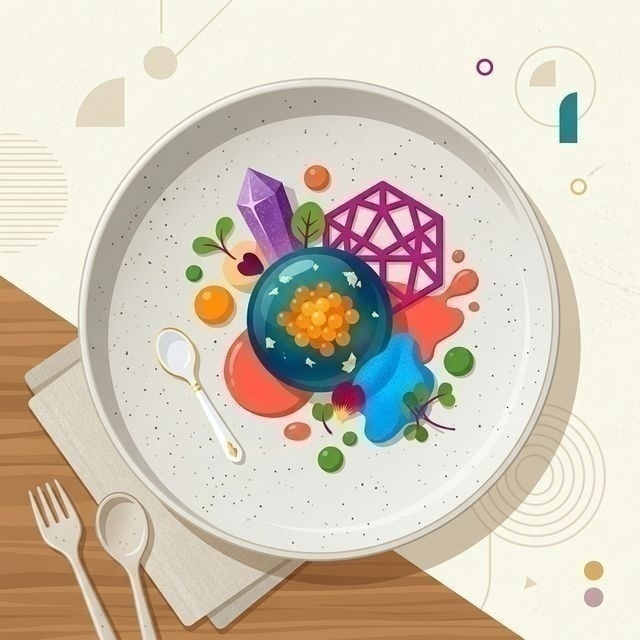
Imagine a world where your palate is no longer limited by tradition, but guided by the precise chemistry of a machine. Artificial Intelligence is now diving into the molecular blueprints of ingredients to uncover combinations that defy intuition but delight the senses.
Traditional cooking relies on history and habit, but AI uses deep learning to find shared chemical compounds between ingredients that seem like polar opposites. By mapping thousands of volatile molecules, technology is helping chefs and food scientists create “impossible” pairings—like blue cheese and white chocolate or strawberry and balsamic—opening up a new frontier of culinary creativity that the human brain alone could never have mapped.
The Architecture of Taste: Beyond the Tongue
For centuries, culinary evolution moved at the speed of trial and error. We paired tomatoes with basil because they grew in the same soil, and lemon with fish to mask saltiness. However, the true secret of flavor isn’t on the vine; it’s in the molecular structure. Every ingredient contains hundreds of volatile organic compounds (VOCs) that trigger our olfactory and gustatory systems.
Molecular flavor profiling uses AI to analyze these VOCs, identifying “flavor bridges”—shared chemical components—between seemingly unrelated foods. When two ingredients share key molecular markers, they harmonize on the palate, even if our cultural logic says they shouldn’t.
The Flavor Network Theory
At the heart of this revolution is the “Flavor Network Theory.” Researchers have found that Western cuisines tend to pair ingredients that share many flavor compounds. In contrast, East Asian cuisines often pair ingredients that share very few.
AI models, such as those developed by companies like Foodpairing or IBM’s Chef Watson, process massive datasets of chemical profiles. They look for:
* Esters: Often providing fruity or floral notes.
* Pyrazines: Responsible for roasted, nutty, or savory aromas.
* Terpenes: Giving citrusy or herbal characteristics.
By calculating the “chemical distance” between ingredients, AI can predict with startling accuracy whether a pairing will be a disaster or a masterpiece. This isn’t just about taste; it’s about creating a sensory “thrum” that occurs when compounds lock together like a key in a molecular lock.
Breaking the Culinary Matrix: Unexpected Pairings
What does an AI-driven menu actually look like? It looks like a map of the unexpected. Here are some of the most successful “impossible” pairings discovered through molecular profiling:
- White Chocolate and Caviar: Both share high levels of trimethylamine and other amines, creating a rich, savory-sweet explosion.
- Coffee and Garlic: While it sounds like a nightmare, they share several sulfur-containing compounds that, when balanced, create an earthy, umami depth.
- Strawberry and Balsamic Vinegar: Now a classic, this was once a “hidden” pairing identified by the shared presence of furaneol.
- Pineapple and Blue Cheese: Linked by the presence of methyl hexanoate, an ester that bridges the gap between tropical fruit and pungent dairy.
From High-End Labs to Your Kitchen
This technology isn’t just for Michelin-starred chefs like Heston Blumenthal. Food corporations are using AI to solve a more pressing problem: sustainability. As the world moves toward plant-based diets, AI is being used to find molecular “twins” for animal products.
By analyzing the molecular profile of beef, AI can scan thousands of plants to find a combination of legumes, grains, and fungi that mimic the exact “bloodiness” and fat-render of a steak. This is “computational gastronomy,” and it is the foundation of the next generation of meat alternatives.
The Future: Personalized Flavor Profiles
We are moving toward a future where “flavor” is personalized. Everyone has a unique distribution of taste receptors and olfactory sensitivities. In the near future, AI could analyze your DNA or your recent biometric data to suggest ingredient pairings that would specifically stimulate your brain’s pleasure centers.
Molecular profiling is proving that we have only scratched the surface of what is delicious. By removing human bias and cultural baggage, AI is allowing us to taste the world in high definition, one molecule at a time.
Comparison: Traditional vs. AI-Driven Flavor Development
| Feature | Traditional Culinary Pairing | AI Molecular Profiling |
|---|---|---|
| Foundation | Cultural history and regional availability. | Chemical compound analysis (VOCs). |
| Method | Sensory trial and error by chefs. | Data-mining across millions of data points. |
| Logic | “What grows together, goes together.” | “Shared molecules create harmony.” |
| Discovery Speed | Centuries of evolution. | Seconds of processing power. |
| Result | Familiar, “safe” flavor profiles. | Disruptive, “impossible” pairings. |
| Application | Home cooking and classic restaurants. | Food science, sustainability, and avant-garde dining. |
Conclusion
The bridge between technology and the kitchen is no longer a gap—it’s a superhighway. As AI continues to decode the hidden language of molecules, our dinner plates will become canvases for combinations we never dreamed possible. We aren’t just eating food anymore; we are experiencing the data of deliciousness.